
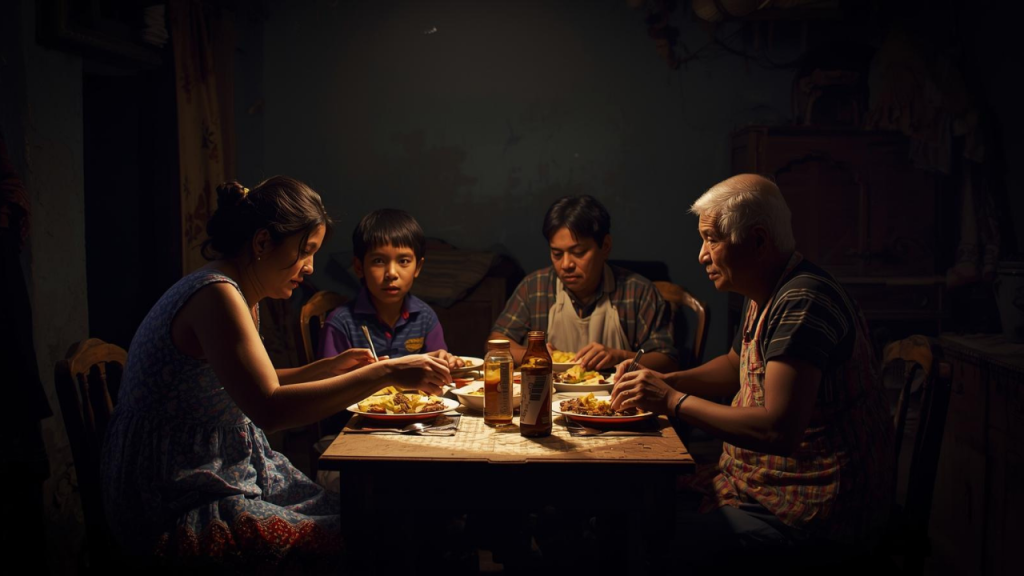

The house woke before the sun.
Not because anyone wanted to, but because hunger does not respect sleep. The tin roof trapped the night’s cold, and the single bulb flickered as if undecided about staying on. Shanta rose quietly, careful not to wake the children too soon. She tied her sari, filled a pot with water, and lit the stove with practiced patience.
There was rice left for one meal.
She counted it twice.
Across the room, her husband Ramesh sat on the edge of the bed, rubbing his hands together. The factory where he worked had reduced shifts again. “Temporary,” the supervisor said. Temporary had stretched into months.
“I’ll go early,” Ramesh murmured. “Maybe there’s day work.”
Shanta nodded. Hope, like everything else, was rationed.
Their children—Kavya, ten, and Aman, seven—woke to the smell of boiling water. Breakfast was thin porridge, shared carefully. Kavya noticed the smaller portion in her mother’s bowl.
“You’re not hungry?” she asked.
“Later,” Shanta replied, smiling.
School uniforms were washed nightly and dried by morning, faded but clean. Education was the one thing Shanta refused to compromise on. “Books can carry you farther than feet,” she often said.
Ramesh left with his lunch wrapped in newspaper—two rotis and salt. The city swallowed him quickly.
The day stretched long.
Shanta stitched blouses for neighbors, fingers aching, eyes straining. Payment came slowly, sometimes not at all. By noon, the heat pressed in, and the children returned from school with stories and questions Shanta answered gently, even when worry crowded her chest.
Aman asked for milk.
Shanta’s smile faltered only for a second. “Tomorrow,” she said.
In the evening, Ramesh returned empty-handed. He sat quietly, staring at the floor.
“I’ll try again,” he said.
That night, rain began without warning. Water leaked through the roof, pooling near the bed. Shanta placed buckets and towels, moving with quiet efficiency. Kavya watched, memorizing the choreography of survival.
Weeks passed like this—meals measured, promises deferred, dignity tested daily.
Then Kavya fell ill.
The fever climbed quickly. Shanta held her through the night, whispering prayers. At the clinic, the doctor wrote a prescription and said a word that made Shanta’s knees weak: tests.
They did not have money for tests.
Ramesh sold his old bicycle.
The fever broke. Relief flooded the house like sunlight after rain.
The next day, Shanta took Kavya with her to deliver finished blouses. An elderly woman examined the stitching closely, then nodded.
“You’re careful,” she said. “Come twice a week.”
It wasn’t much, but it was steady.
Ramesh found temporary work unloading sacks at dawn. His hands blistered. He came home exhausted, but lighter. “It’s honest,” he said, as if honesty itself could fill a plate.
Aman began collecting bottles to sell. Kavya tutored a neighbor’s child in the evenings. No one complained. They learned to contribute without being asked.
One afternoon, a school notice arrived—Kavya had been selected for a scholarship exam.
Shanta held the paper like a fragile thing.
“What if I fail?” Kavya asked.
“Then you try again,” Shanta said. “Failing is not finishing.”
The exam day came. Kavya walked into the hall wearing borrowed shoes, carrying sharpened pencils and a quiet resolve. She wrote carefully, steadily, as if stitching answers into place.
The results arrived weeks later.
Kavya passed.
The scholarship didn’t solve everything. It didn’t fix the roof or guarantee meals.
But it changed the air in the room.
They celebrated with sweet tea. Ramesh laughed for the first time in months. Shanta closed her eyes and breathed.
Poverty did not disappear.
But neither did they.
They learned that survival was not only about endurance.
It was about showing up, sharing what little there was, and believing that tomorrow could be negotiated—one careful step at a time.


