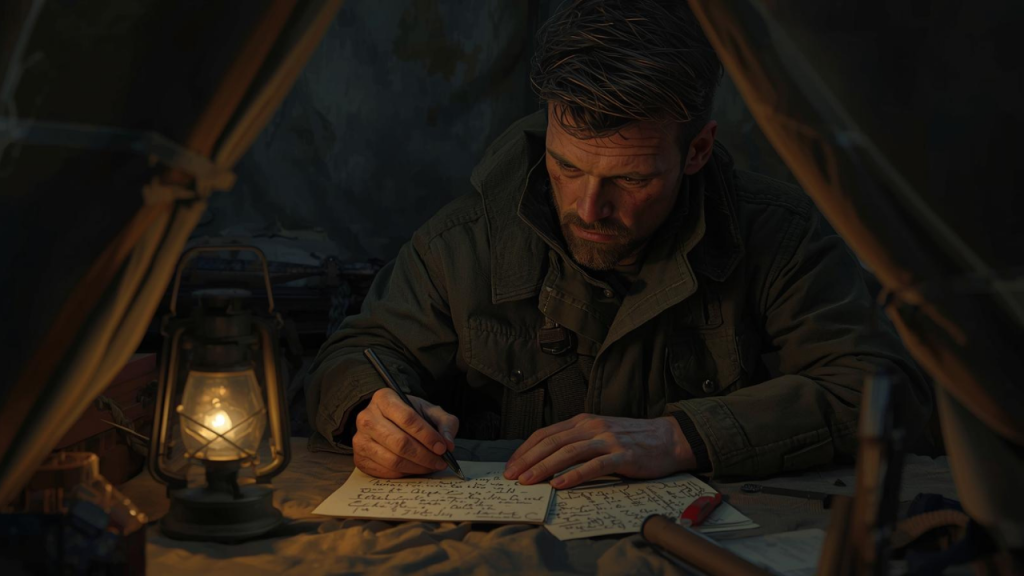

The nights were the hardest.
When the camp finally fell quiet and the mountains stood dark and unmoving against the sky, Captain Arvind sat outside his tent with a small torch and a notebook balanced on his knee. The cold crept into his bones, but he barely noticed. Writing was the only way he knew how to travel home without leaving his post.
Letters had become his lifeline.
In a world filled with commands, boots, and watchful silence, words were the only place where Arvind allowed himself to be soft.
“Dear Ma,” he began, the familiar greeting steadying his hands.
He wrote to his mother first, always. She worried the most, even though she pretended to be strong. Arvind chose his words carefully, leaving out the dangers and long nights, focusing instead on small comforts.
The food here is better than you’d expect. Don’t worry, I’m eating well. The mountains are beautiful in the mornings.
He imagined her reading the letter slowly, lips moving as she followed each line. That image brought him comfort.
He never wrote about the fear.
Arvind had joined the army at twenty-three, driven by a mix of patriotism and restlessness. His family was proud, though their pride came with quiet concern. His father rarely spoke about it, but Arvind saw the worry in his eyes every time he left on leave.
Now, at thirty, stationed near the border, Arvind understood their fear better.
War was not like the movies.
It was waiting.
Listening.
Holding your breath in the dark.
After his mother, he wrote to his younger sister, Kavya.
“Dear Kavya,” he smiled as he wrote, “I heard you topped your class again. I’m not surprised. You were always smarter than me.”
He told her to focus on her studies, to listen to Ma, to dream without limits. He slipped encouragement into every sentence, hoping his words might shield her from worry.
He asked her to describe home in detail—the new paint on the walls, the neighbor’s dog, the mango tree in the courtyard.
He missed those details more than he expected.
Sometimes, Arvind wrote to his father, even though his father rarely replied.
“Dear Papa,” he wrote one night, hesitating. “I hope you’re taking care of your health. Don’t skip your walks.”
He wanted to say more. To say thank you. To say he understood now. But some emotions felt too heavy to put into words.
So he wrote what he could.
Letters took weeks to arrive.
Replies came slower.
When one finally did, Arvind read it over and over until the paper softened in his hands. His mother’s handwriting leaned slightly to the right, familiar and comforting.
We are proud of you. We pray for you every day. The house feels empty without you, but your letters bring life back into it.
Arvind closed his eyes.
That was enough.
One night, after a particularly difficult patrol, Arvind sat down to write again. His hands shook slightly, fatigue and tension mixing together. He stared at the blank page longer than usual.
This time, he didn’t know what to say.
The reality of loss had brushed too close that day. A fellow soldier had been injured. The reminder of how fragile life was felt unbearable.
Finally, he began.
Dear Ma,
Some days are harder than others. But I want you to know that I’m okay. And even when it’s difficult, thinking of home gives me strength.
It was the closest he came to the truth.
Arvind also wrote letters he never sent.
Letters to the future. Letters to himself. Letters to a life waiting beyond the uniform.
He wrote about the things he would do when he returned—morning tea at home, long walks without watching his back, listening to his sister complain about small things.
Those unsent letters stayed folded in his bag, a promise to himself that there was life beyond the border.
One evening, the camp received mail.
Arvind’s heart raced as his name was called. He took the envelope eagerly, stepping aside to read it.
Inside was a drawing from Kavya—a simple sketch of their house, with a stick figure labeled “Bhai” standing at the gate.
On the back, she had written:
Come home soon.
Arvind smiled, eyes burning.
The next night, Arvind wrote one more letter.
Dear Home, he began, surprising himself.
I carry you with me everywhere. In my pocket. In my thoughts. In my courage. Every step I take here is so that one day I can return safely to you.
He folded the letter carefully.
The wind whispered through the camp, carrying distant sounds of duty. Arvind stood, tucked the letters safely away, and looked up at the sky.
He knew not all letters promised happy endings.
But as long as he could write—
As long as he could remember who he was fighting for—
He would endure.
Because sometimes, a soldier’s strongest weapon isn’t a rifle.
It’s the words that remind him why he must survive.