
The city never slept, but it rarely noticed him.
Ramesh sat on the cold pavement near the bus stand, wrapped in a torn blanket that barely protected him from the night air. People passed by in a hurry—some talking on phones, some laughing, some staring straight ahead as if he didn’t exist. A few glanced at him briefly, then looked away, uncomfortable.
He had learned not to expect anything.
Not kindness.
Not sympathy.
Not hope.
At fifty-two, Ramesh had lived on the streets for nearly six years. Once, he had a home, a family, a life that made sense. But loss had a way of pulling the ground out from under you when you least expected it.
Ramesh used to be a factory worker. His hands were strong then, his back straight, his future simple. He earned just enough to keep his small family comfortable. His wife, Sita, worked part-time, and their daughter, Meena, filled the house with laughter.
Then the factory shut down.
At first, Ramesh believed it was temporary. He took odd jobs, promised his family things would improve. But weeks turned into months. Savings disappeared. Stress crept in. Sita fell ill, and medical bills piled up faster than hope.
By the time she passed away, Ramesh was drowning—in debt, grief, and guilt.
Meena went to live with relatives. Ramesh lost the house shortly after.
The street became his address.
Life on the street was cruel in quiet ways.
Rain soaked his clothes. Hunger burned constantly. Nights were long and unsafe. People spoke about him but rarely to him. He became invisible, reduced to a shape people stepped around.
What hurt most wasn’t the hunger.
It was the feeling that he no longer mattered.
Some days, Ramesh questioned why he kept going. Hope felt like a word meant for other people.
One winter morning, Ramesh woke up shivering uncontrollably. Fever blurred his vision. His body felt heavier than usual. He tried to stand but collapsed back onto the pavement.
People walked past.
Some slowed. Some stared. Most didn’t stop.
Ramesh closed his eyes, exhausted, expecting nothing.
Then a voice broke through the noise.
“Uncle… are you okay?”
He opened his eyes slowly.
A young boy stood in front of him, no older than twelve, holding a schoolbag. Concern filled his face.
“I’m fine,” Ramesh whispered automatically, though it was a lie.
The boy frowned. “You don’t look fine.”
Before Ramesh could protest, the boy ran toward a nearby tea stall. Moments later, he returned with a cup of hot tea.
“Here,” the boy said, placing it carefully in Ramesh’s shaking hands. “Drink.”
The warmth burned gently, spreading through his body. Tears stung Ramesh’s eyes—not from the heat, but from the surprise.
“Why?” Ramesh asked softly.
The boy shrugged. “My mother says if you can help someone, you should.”
That simple answer stayed with Ramesh long after the boy left.
That day changed something.
Not his situation.
But his heart.
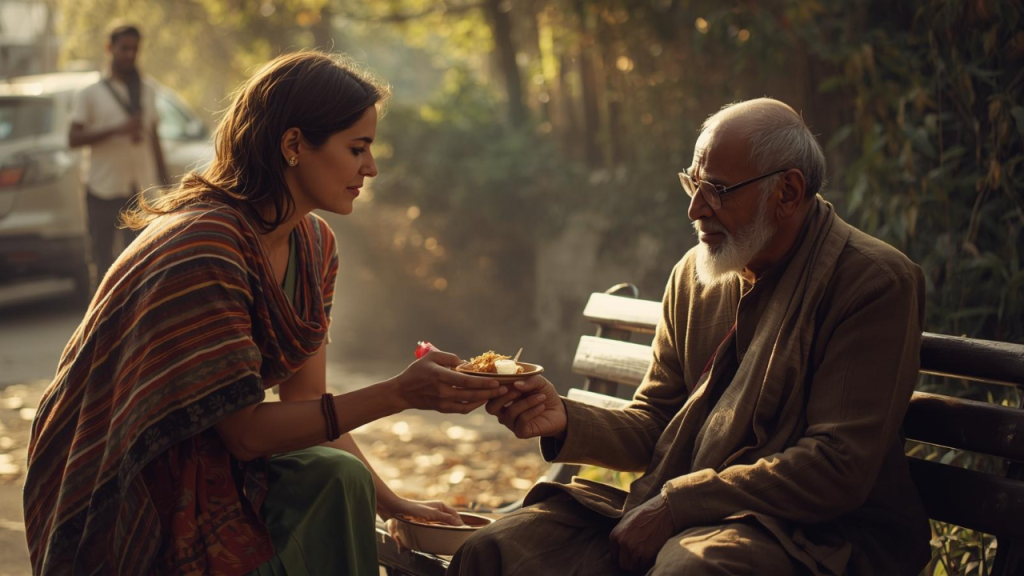
In the days that followed, small acts of kindness appeared where he least expected them. A shopkeeper who offered leftover food without being asked. A woman who placed a blanket beside him without saying a word. A bus conductor who smiled instead of scolding.
They weren’t grand gestures.
But they were real.
For the first time in years, Ramesh felt seen.
One evening, as he sat near a temple, an elderly man approached him.
“You look like you can work,” the man said kindly. “Can you help me clean my storeroom tomorrow? I’ll pay you.”
Ramesh hesitated. “I’m slow.”
“That’s okay,” the man replied. “I’m older.”
The next day, Ramesh showed up early. His hands trembled as he worked, but his body remembered effort. When the man paid him honestly and offered food, Ramesh felt something unfamiliar.
Dignity.
Work led to more work. Cleaning. Carrying. Helping. It wasn’t much, but it was steady. Slowly, Ramesh began saving small amounts.
More importantly, he began believing again.
One afternoon, Ramesh noticed a group of children playing near the pavement. One little girl dropped her toy and looked around, confused. Without thinking, Ramesh picked it up and handed it to her.
“Thank you, Uncle!” she smiled.
That smile did something to him.
He realized he wasn’t just receiving kindness anymore.
He was giving it too.
Months passed.
Ramesh found a spot at a night shelter. It wasn’t home, but it was safe. He washed regularly, found cleaner clothes through donations, and stood a little straighter.
One evening, a volunteer at the shelter asked him, “What’s your name?”
“Ramesh,” he replied.
The volunteer smiled. “Nice to meet you, Ramesh.”
No one had said his name kindly in a long time.
On a quiet night, sitting under the same bus stand lights, Ramesh thought about everything that had changed. His life was still difficult. He was still poor. Still uncertain about tomorrow.
But something important had returned.
Hope.
Not because the world suddenly became kind.
But because even in its harshness, humanity still existed—in a cup of tea, a smile, a helping hand, a child’s concern.
Ramesh looked up at the city lights and breathed deeply.
He wasn’t invisible anymore.
And as long as kindness lived in people’s hearts, he believed, there was still a place for him in this world.