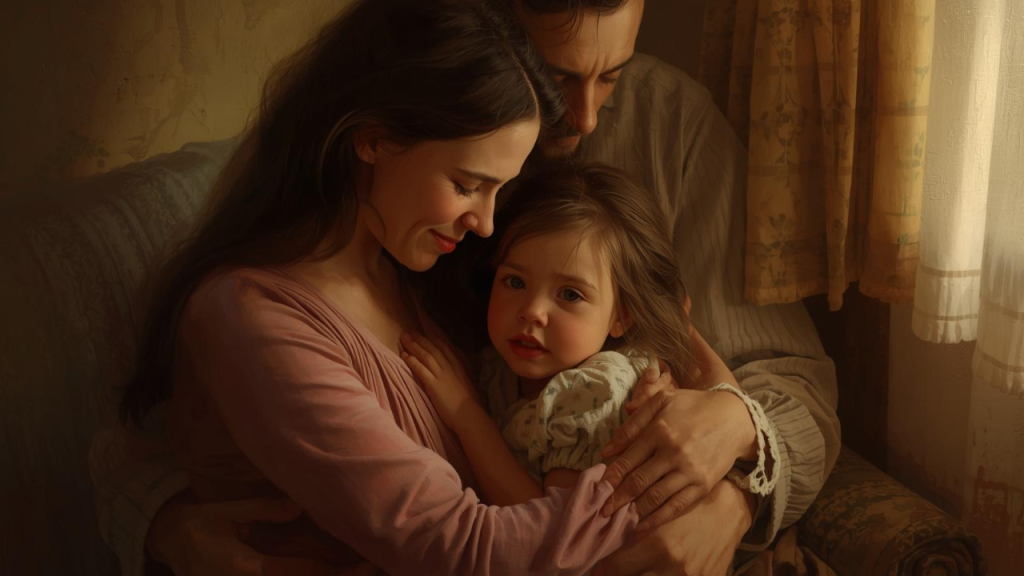

The nursery room stayed empty for three years.
Meera dusted it every Sunday anyway—straightening the small bookshelf, smoothing the pale-blue curtains, adjusting a teddy bear that waited patiently on the bed. Rohan never said anything when he saw her doing it. He simply stood in the doorway, hands in his pockets, carrying hope and grief in equal measure.
They had tried everything.
Doctors. Treatments. Timelines. Quiet prayers whispered at night. Each attempt ended with the same gentle shake of a head and words that landed softly but hurt all the same.
“I’m sorry.”
For a long time, Meera believed her heart had learned how to endure emptiness.
She was wrong.
The idea of adoption arrived slowly, like a thought too fragile to speak out loud.
It came one evening when Meera and Rohan were walking home after visiting a friend who had just had a baby. They smiled, congratulated, held the tiny fingers—and then returned to their silent house.
Meera broke first.
“What if,” she said quietly, “we don’t wait anymore?”
Rohan knew what she meant.
He didn’t answer immediately. He watched the road ahead, headlights passing like unanswered questions.
“I’m scared,” he admitted. “What if we’re not enough?”
Meera reached for his hand. “What if love is?”
The adoption agency building was painted a cheerful yellow that felt almost inappropriate. Inside, the walls were lined with photographs—children smiling, some hopeful, some guarded.
The counselor spoke gently, explaining processes, paperwork, patience.
“There’s no perfect child,” she said. “And no perfect parents. Only families that choose each other.”
That sentence stayed with them.
They met Aarav on a rainy afternoon.
He sat in the corner of the playroom, stacking wooden blocks carefully, his movements deliberate. He didn’t rush toward them. He didn’t smile easily.
“How old is he?” Meera asked softly.
“Five,” the caretaker replied. “He’s been here since he was two.”
Meera knelt beside him. “Hi,” she said.
Aarav glanced at her briefly, then returned to his blocks.
Rohan watched, unsure.
“Can I help?” Meera asked gently.
Aarav considered this, then slid a block toward her.
That was all.
But it felt like everything.
The visits became routine.
Every Saturday, Meera and Rohan returned to the playroom. Sometimes Aarav spoke. Sometimes he didn’t. Sometimes he played alone. Sometimes he let Meera read to him while Rohan built puzzles nearby.
Trust grew quietly.
One day, Aarav asked, “Are you leaving?”
Meera’s chest tightened. “We’ll come back,” she said honestly.
He nodded, as if filing the information away carefully.
The paperwork took months.
Interviews. Home checks. Training sessions. Nights filled with doubt and whispered conversations.
“What if he doesn’t bond?”
“What if we mess this up?”
“What if we hurt him without meaning to?”
The counselor’s words returned often.
Families choose each other.
The day Aarav came home, he carried a small bag with two shirts, a toy car, and a notebook filled with drawings.
Meera had imagined the moment a hundred times—tears, hugs, celebration.
Instead, Aarav stood in the doorway silently, clutching his bag, eyes scanning every corner.
Rohan knelt beside him. “This is your home now,” he said gently.
Aarav didn’t reply.
He stepped inside slowly.
The first weeks were hard.
Aarav woke up crying at night. He hoarded food under his bed. He flinched at raised voices—even laughter. He called Meera “Aunty” and Rohan “Uncle,” refusing the words they hoped for.
Meera cried in the bathroom sometimes.
Rohan felt helpless more often than he admitted.
But they stayed.
They explained routines. They kept promises. They spoke softly even when exhausted.
Love, they learned, wasn’t instant.
It was consistent.
One evening, Aarav spilled juice on the floor and froze, fear flooding his face.
“I’m sorry,” he whispered. “I didn’t mean to.”
Meera cleaned the floor calmly. “It’s okay,” she said.
Aarav waited for anger that didn’t come.
Rohan smiled. “Accidents happen.”
Aarav looked confused.
Then relieved.
The first time Aarav laughed loudly, it startled them both.
It happened during a silly game Rohan invented, complete with ridiculous sound effects. Aarav covered his mouth at first, unsure if he was allowed to enjoy it.
Then he laughed again.
Meera watched from the doorway, tears slipping down her cheeks.
Weeks later, on a quiet Sunday morning, Aarav climbed into bed between them.
He didn’t ask.
He just settled in, warm and trusting.
Meera held her breath.
“Amma?” Aarav said softly, testing the word like something precious.
Her heart broke open.
“Yes,” she whispered. “I’m here.”
Rohan turned away, blinking rapidly.
School began. New challenges followed.
Aarav struggled with separation, with sharing, with believing good things lasted. But each day, Meera picked him up on time. Each night, Rohan read him stories.
Promises kept became proof.
One night, Aarav brought his notebook to Meera.
Inside was a new drawing—three stick figures holding hands in front of a house.
“Who’s this?” Meera asked.
Aarav pointed. “Me. You. Papa.”
The word felt like a blessing.
Adoption didn’t erase Aarav’s past.
It didn’t erase Meera and Rohan’s longing either.
But it gave all three of them something stronger than what they had lost.
Belonging.
One evening, as they sat together eating dinner—messy, noisy, imperfect—Rohan looked around the table and smiled.
“We didn’t just adopt a child,” he said quietly.
Meera nodded. “We became a family.”
Aarav grinned, sauce on his chin, joy in his eyes.
And in that small, ordinary moment, love finally filled the room that had waited so long to be home.