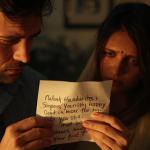
The card was crooked.
The paper was folded unevenly, the edges torn slightly because the scissors had slipped. Inside, the letters wobbled, some bigger than others, written with intense concentration.
Yet it was the most powerful thing Meena had received in years.
Eight-year-old Ansh didn’t know his family was struggling.
He didn’t understand hospital bills, unpaid loans, or the quiet arguments his parents thought he couldn’t hear. He only knew that his mother no longer sang while cooking, that his father came home tired and silent, and that smiles had become rare in their small home.
Ansh noticed everything.
Children always do.
Meena worked as a tailor from home, stitching clothes late into the night. Her fingers ached, her eyes burned, but she pushed on. Since her husband Ravi lost his job, she had become the steady center holding the family together.
Some days, the weight felt unbearable.
One evening, as Meena stitched under the dim light, Ansh sat nearby doing homework. He watched her quietly for a long time.
“Maa,” he asked softly, “are you tired?”
Meena smiled without looking up. “A little.”
Ansh nodded, absorbing that answer.
The next morning, Ansh woke up earlier than usual.
He tiptoed around the house, careful not to wake anyone. He took out his crayons, an old sheet of paper, and sat at the small table. His tongue peeked out in concentration as he worked slowly, seriously, like it was the most important task in the world.
He folded the paper clumsily when he was done.
Then he waited.
That afternoon, Meena returned home after buying groceries. Her shoulders drooped as she unlocked the door. Inside, the house looked the same—but something felt different.
On the table lay a small card.
“For Maa,” it said.
Meena frowned in confusion and picked it up.
Inside was a simple drawing—her and Ansh holding hands under a sun with a big smile. Below it, in uneven letters, were the words:
“Maa, you work very hard. I love you. Don’t be sad.”
Meena froze.
Her throat tightened. Her vision blurred.
She sat down slowly, the grocery bag slipping from her hand.
Ansh stood nearby, watching nervously.
“Did I spell it wrong?” he asked.
Meena shook her head, tears streaming freely now. She pulled him into a tight hug.
“No, beta,” she whispered. “You spelled it perfectly.”
Ansh hugged her back, surprised by her tears but holding on anyway.
That small card did something years of reassurance hadn’t.
It made Meena feel seen.
Not as a provider.
Not as a problem-solver.
But as a mother who mattered.
That night, Meena cooked dinner with more energy than she had in weeks. Ravi noticed.
“You seem lighter,” he said.
Meena smiled and handed him the card.
Ravi read it quietly.
Then he wiped his eyes and laughed softly. “We’re doing something right,” he said.
Ansh didn’t stop there.
In the days that followed, he expressed his love in ways only a child could—small, innocent, powerful.
He brought Meena water when she stitched.
He cleaned his plate without being asked.
He kissed her cheek before school and said, “Smile, okay?”
Each gesture felt like a stitch repairing something invisible.
One evening, Meena fell sick with fever.
Usually, she would still push herself to work.
This time, Ansh stood firmly in front of her.
“You rest,” he said seriously. “I’ll be quiet.”
Meena laughed weakly. “Deal.”
Ansh sat beside her bed, drawing silently, glancing at her every few minutes to make sure she was okay.
Love doesn’t always need words.
Sometimes, it just needs presence.
Weeks passed.
Ravi found temporary work. Money was still tight, but the house felt warmer. Laughter returned slowly, cautiously, like a guest afraid of overstaying.
Meena framed the card and placed it near her sewing machine.
Whenever exhaustion returned, she looked at it.
And remembered why she kept going.
One day, Ansh’s teacher called Meena to school.
“He’s very kind,” the teacher said. “He helps other children without being asked.”
Meena smiled proudly.
At home that evening, she hugged Ansh tightly.
“Where did you learn to love like this?” she asked.
Ansh shrugged. “From you.”
Years later, when Ansh was older, Meena would still keep that card safely stored. The paper yellowed with time, the ink faded—but the feeling never did.
Because that small, imperfect card carried a truth bigger than words:
Love doesn’t have to be loud to be powerful.
Sometimes, it just needs to be sincere.
And in that small gesture from a child’s heart, a family found strength to keep going—together.