
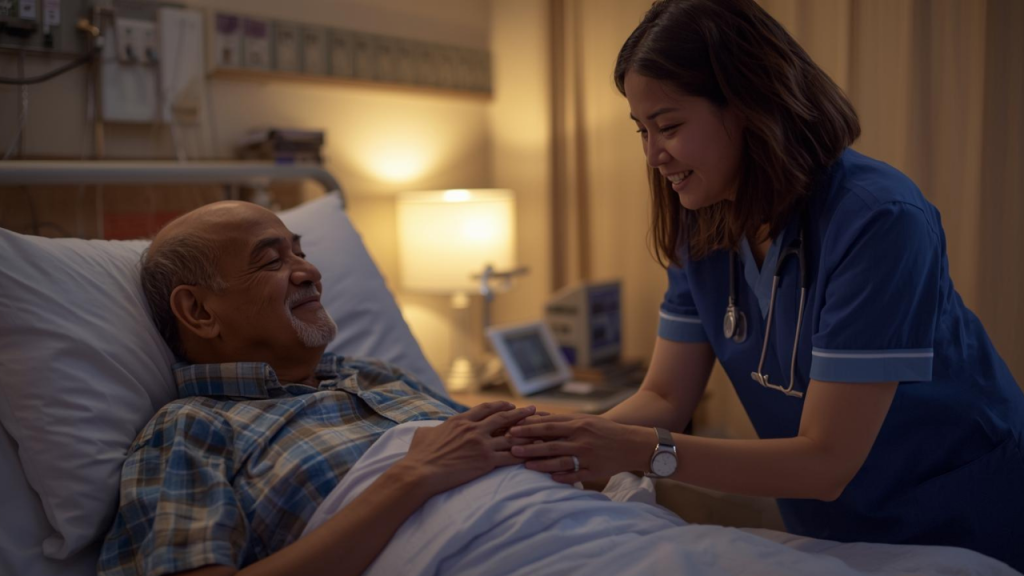

The first thing Maya noticed about Room 214 was the silence.
Hospitals were never truly quiet—machines beeped, carts rattled, footsteps echoed—but this room felt withdrawn from all of it. The curtains were always half drawn. The television stayed off. And the man in the bed rarely spoke.
His name was Mr. Thomas.
Seventy-two years old. Stroke survivor. Limited mobility. “Uncooperative,” the file said.
Maya didn’t like that word.
She adjusted her badge and stepped inside. “Good morning, Mr. Thomas. I’m Maya. I’ll be helping you today.”
He didn’t look at her.
That was how it went for the first few days.
Maya had been a caregiver for five years. She had learned quickly that healing wasn’t just about medicine—it was about dignity, patience, and presence. Still, Mr. Thomas tested all three.
He refused meals. Turned his face away during therapy. Responded to questions with silence or short, sharp words.
“Leave it,” he muttered once when Maya tried to help him sit up.
She stepped back calmly. “Okay. I’ll be right here if you change your mind.”
She always stayed.
Other staff warned her.
“He wasn’t like this before,” one nurse said. “After the stroke, he just… shut down.”
Maya nodded. She had seen it before—people grieving the life they lost while still being alive.
One afternoon, while changing the bedsheets, Maya noticed a small wooden carving on the side table. A bird, wings outstretched, worn smooth by time.
“You made this?” she asked gently.
Mr. Thomas glanced at it briefly. “Long ago.”
“It’s beautiful,” Maya said honestly.
He didn’t reply—but he didn’t turn away either.
That felt like progress.
Days turned into weeks.
Maya learned Mr. Thomas’s routines—how he liked his tea, when his pain worsened, the exact way to support his arm so it didn’t ache. She talked even when he didn’t respond, filling the silence with ordinary things.
“The rain smells different today,” she said once.
“My mother used to make soup like this,” another time.
Sometimes, she read aloud from the newspaper. Other times, she simply sat quietly.
One evening, as she adjusted his blanket, Mr. Thomas spoke unexpectedly.
“My wife used to hum when she cooked.”
Maya froze, afraid to break the moment. “What did she like to cook?”
“Apple pie,” he said softly. “Burnt the edges every time.”
Maya smiled. “Sounds perfect.”
For the first time, Mr. Thomas smiled too—just barely.
From then on, the walls cracked.
He told her about his woodworking shop, the smell of sawdust, the pride of making something with his hands. About his wife, Eleanor, and how the house felt too big after she passed. About the stroke that stole not just movement, but confidence.
“I hate needing help,” he admitted one day, voice rough.
Maya met his eyes. “Needing help doesn’t make you weak. It makes you human.”
Tears filled his eyes. He looked away, ashamed.
Maya stayed silent, letting him have the space.
Therapy improved slowly.
Mr. Thomas still struggled, but he tried—for Maya. He lifted his arm a little higher. Took a few more steps. Ate more than a few bites.
One morning, he said, “You don’t talk to me like I’m broken.”
Maya smiled. “Because you’re not.”
He nodded, absorbing the truth like medicine.
The bond surprised Maya too.
She found herself thinking about Mr. Thomas after shifts ended, worrying when he had a bad day, celebrating small victories as if they were her own. She brought in an apple pie from a local bakery one afternoon.
“Edges slightly burnt,” she said.
Mr. Thomas laughed—a full, warm laugh that filled the room.
“I’d forgotten what that sounded like,” he said.
Change came suddenly.
One evening, the head nurse called Maya aside. “Mr. Thomas is being transferred to a long-term facility tomorrow.”
Maya’s chest tightened. “Tomorrow?”
She returned to Room 214 quietly.
“I heard you’re leaving,” she said.
Mr. Thomas nodded slowly. “Yes.”
They sat in silence, heavier than before.
“I won’t forget you,” he said finally. “You reminded me I’m still here.”
Maya swallowed hard. “You reminded me why I do this.”
The next day, as the transport team arrived, Mr. Thomas reached for her hand.
“I never said thank you,” he said.
“You don’t have to,” Maya replied.
But he held her hand tighter. “I want to.”
Before he left, he pressed the wooden bird into her palm.
“For you,” he said. “So you remember.”
Maya shook her head. “I can’t—”
“I made it to fly,” he said. “And you helped me do that.”
Weeks later, Maya still carried the bird in her bag.
Some days were hard. Some patients were distant. Some outcomes were unfair.
But whenever she doubted herself, she remembered Room 214.
She remembered that healing didn’t always mean recovery.
Sometimes, it meant connection.
And sometimes, the bond between a caregiver and a patient was the strongest medicine of all.


