
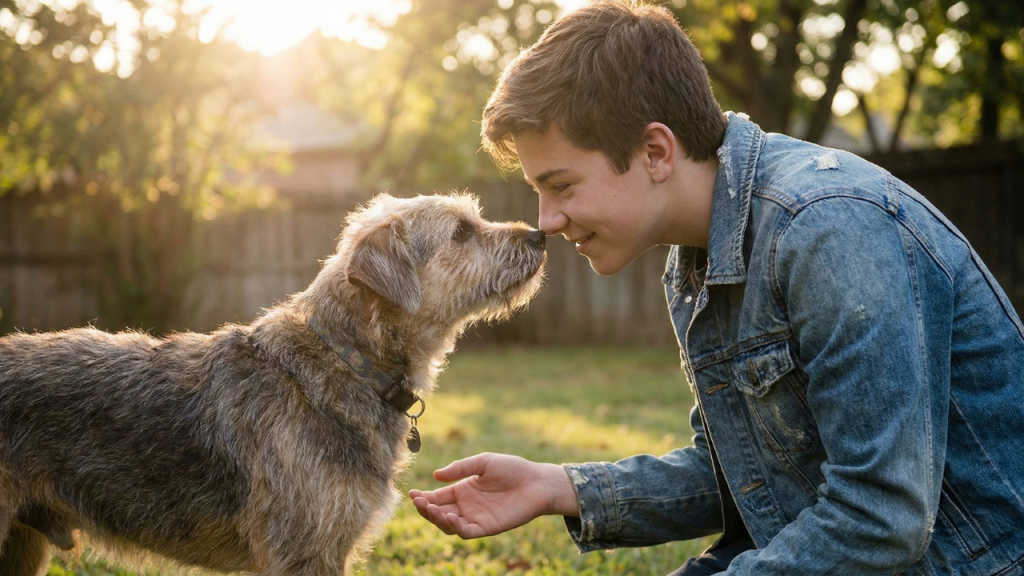

The dog had learned early that silence was safer than sound.
In the narrow alley behind the closed textile mill, he curled himself into a tight shape each night, ribs pressing against cold concrete, tail wrapped protectively around his hind legs. Rainwater pooled in the cracks, and the smell of rust and garbage clung to the air. Cars passed at the far end of the lane, their headlights flashing briefly like distant lightning. He did not chase them anymore. He did not bark. Barking had once brought pain.
Once, long ago, he had a name.
He remembered fragments of another life—the warmth of a kitchen floor, a child’s laughter, the sound of a whistle that meant food. He remembered running without fear and sleeping without hunger. But memories were dangerous. They softened him. And softness, he had learned, invited cruelty.
The day he was abandoned replayed in his mind without warning. The car door opening. A familiar hand pushing him gently out. The engine starting again before he could climb back in. He had run after the car until his legs burned and his breath failed him. When the car disappeared, something inside him broke quietly.
After that came the streets.
Hunger taught him caution. Humans taught him fear. Some threw stones for fun. Some kicked. Some laughed. He learned to flinch at raised hands and avoid eye contact. He learned which garbage bins were safe and which were guarded. He learned that trusting anyone meant risking everything.
By the time winter arrived, his fur was matted, one ear torn from an old fight, his eyes permanently alert. He survived by being invisible.
Then she arrived.
Her name was Anjali, though the dog did not know that yet. She moved into the building near the alley on a quiet Sunday morning, carrying boxes and exhaustion in equal measure. She noticed the dog the first evening while taking out the trash. He watched her from the shadows, muscles tensed, ready to run.
She did not approach.
She simply left a piece of bread near the wall and walked away.
The dog waited a long time before creeping forward. He sniffed the air, expecting a trick. When nothing happened, he ate quickly and retreated.
The next day, there was rice.
The day after that, water.
Always placed gently. Always followed by distance.
The dog did not trust her—but he noticed her consistency. She came every evening at the same time. She never shouted. Never chased. Never tried to touch him. Slowly, the tight knot inside his chest loosened just enough to allow curiosity.
Anjali had her own wounds. She had moved to this city to start over after a life that had collapsed under the weight of betrayal and exhaustion. She worked long hours at a small clinic, treating patients with kindness she rarely extended to herself. The empty apartment echoed when she returned home each night. Feeding the dog became a quiet ritual that made the city feel less cold.
Weeks passed.
The dog began waiting for her.
He did not come close, but he no longer hid completely. Sometimes their eyes met briefly before he looked away. His tail twitched once, then stopped, as if embarrassed by its own hope.
One evening, it rained heavily. Thunder cracked the sky open. Anjali rushed down with food, worried.
She found the dog shivering, soaked to the bone.
Something in her chest tightened. Without thinking, she took off her shawl and placed it a few feet away.
The dog froze.
Cloth meant traps. Cloth meant ropes. He backed away, heart racing.
Anjali stepped back immediately, raising her hands. “It’s okay,” she whispered. “I won’t hurt you.”
Her voice was soft. Tired. Honest.
Hours later, when the rain slowed, the dog crept forward and lay beside the shawl—not on it, just near enough to feel its warmth.
That night, he slept deeper than he had in months.
Trust did not arrive all at once.
It came in inches.
The first time he allowed her to sit on the ground near him, his body shook uncontrollably. The first time her fingers brushed his fur accidentally, he snapped—not in anger, but in terror. Anjali pulled back instantly, apologizing as if she were the one at fault.
“I’m sorry,” she whispered. “I forgot to ask.”
No one had ever asked him before.
The dog began to associate her scent with safety. He followed her at a distance when she walked to the corner shop. He growled at other dogs that came too close to her building. One night, when a stranger lingered too long near her gate, he barked fiercely until the man left.
Anjali noticed the change.
“You’re protecting me now?” she asked softly.
The dog tilted his head, unsure, but proud.
Winter faded into spring. The dog’s fur grew healthier. His eyes softened. One morning, when Anjali reached out slowly, palm open, he did not move away.
Her hand rested gently on his head.
The contact lasted only a second.
But it changed everything.
He leaned into her touch before he could stop himself.
Anjali’s eyes filled with tears.
From that day on, the alley was no longer his home.
He moved into her apartment cautiously, exploring each room like enemy territory. Loud noises still frightened him. Sudden movements made him flinch. But at night, he slept near her bed, close enough to feel her breathing.
She named him Aasha.
“Because you remind me of hope,” she said.
Healing was not simple. There were setbacks. One afternoon, a child tried to grab his tail, and Aasha reacted with panic. Anjali defended him firmly.
“He’s learning,” she said. “Just like people do.”
Months passed.
Aasha learned how to play again. How to wag his tail without fear. How to trust that food would come tomorrow. He learned that hands could be gentle. That voices could be kind.
One evening, Anjali fell ill with a high fever. She collapsed on the sofa, barely conscious. Aasha whimpered, pacing anxiously. When she didn’t respond, he did something he had never done before.
He ran.
Out into the street, barking wildly until a neighbor followed him back. Help arrived in time.
As Anjali recovered, she held Aasha close, her face buried in his fur. “You saved me,” she whispered.
Aasha did not understand the words.
But he understood the feeling.
He was no longer invisible.
He was no longer alone.
Trust, he learned, was not about forgetting the past.
It was about choosing, every day, to believe that kindness could still exist.
And for the first time since the car door closed and drove away, Aasha slept without fear—certain that this time, he would not be left behind.


