
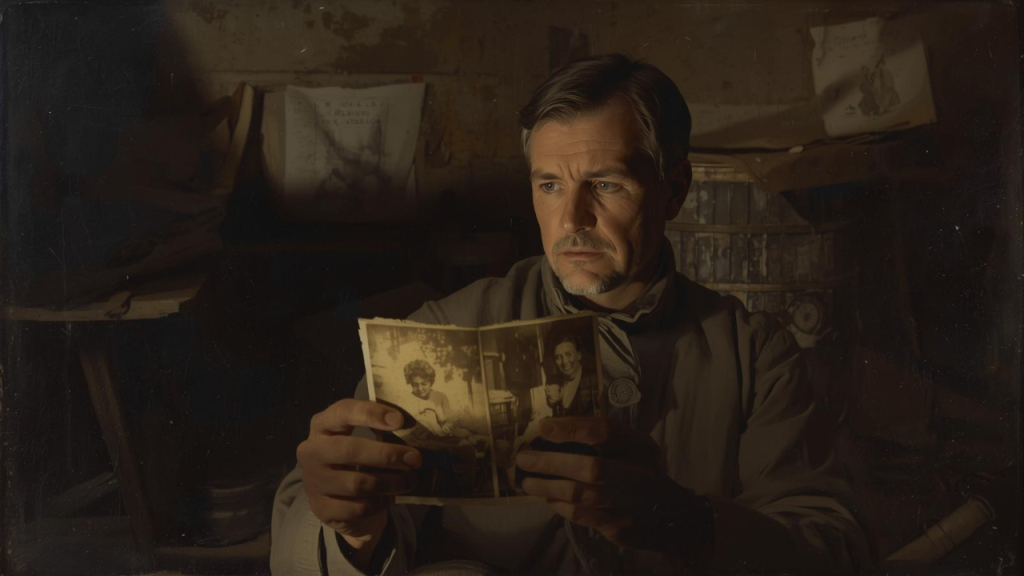

The cupboard creaked when Arjun opened it, protesting the years it had stayed shut.
He had returned home to help his mother pack after the decision she kept postponing—selling the old house. The rooms were smaller than his memory allowed, their corners crowded with dust and quiet. Arjun moved methodically, labeling boxes, avoiding the ache that came with every object.
At the back of the cupboard, behind winter blankets that smelled faintly of mothballs, he found a tin box.
It was locked.
Curiosity nudged him harder than respect. He pried it open with a screwdriver, wincing at the sound. Inside lay photographs, letters tied with thread, and a birth certificate that did not carry his surname.
Arjun sat down.
The name printed there was his.
The parents listed were not.
His breath shortened as if the room had shrunk. He flipped through the letters—handwritten, dated decades earlier. A woman’s careful script spoke of fear and hope, of doing what was necessary, of trusting another family to love a child she could not keep.
Adoption.
The word settled heavily.
Arjun had always felt slightly out of place—features that didn’t match, questions that never fully answered themselves. He had laughed it off. Families come in all shapes, he told himself.
Now, the truth pressed in.
His mother found him sitting on the floor, papers spread like evidence.
“I was going to tell you,” she said quietly.
“When?” Arjun asked, voice steady by effort alone.
“When it felt safe,” she replied. “When you were ready.”
They talked through the afternoon. Of infertility. Of waiting lists. Of the day she held him for the first time and knew she would choose him every day after. She spoke of love fierce enough to protect him from uncertainty—and of the fear that truth might loosen that bond.
Arjun listened, anger and gratitude tangling uncomfortably.
“What about them?” he asked.
She slid a photograph toward him—a young woman with tired eyes and a soft smile.
“She wanted you to live without limits,” his mother said.
That night, Arjun walked alone, letting the city absorb his confusion. Identity felt suddenly fragile, like glass warmed by the sun. Who was he, if his beginning belonged to someone else?
He wrote a letter he didn’t know if he would send.
He asked simple questions. He avoided accusations.
Weeks later, a reply arrived.
She wrote of poverty, of youth, of the choice that broke her heart but saved her child. She wrote of watching from afar, of gratitude for the family that raised him.
Arjun cried then—deep, shaking sobs that surprised him.
He met her in a quiet café months later. They did not rush intimacy. They spoke gently, as people do when holding something delicate. He learned where his dimple came from. She learned that he was okay.
Returning home, Arjun hugged his mother tightly.
“You didn’t lose me,” he said. “You raised me.”
Discovering the secret did not split his life in two.
It added depth.
Some truths don’t replace love.
They explain it.


