
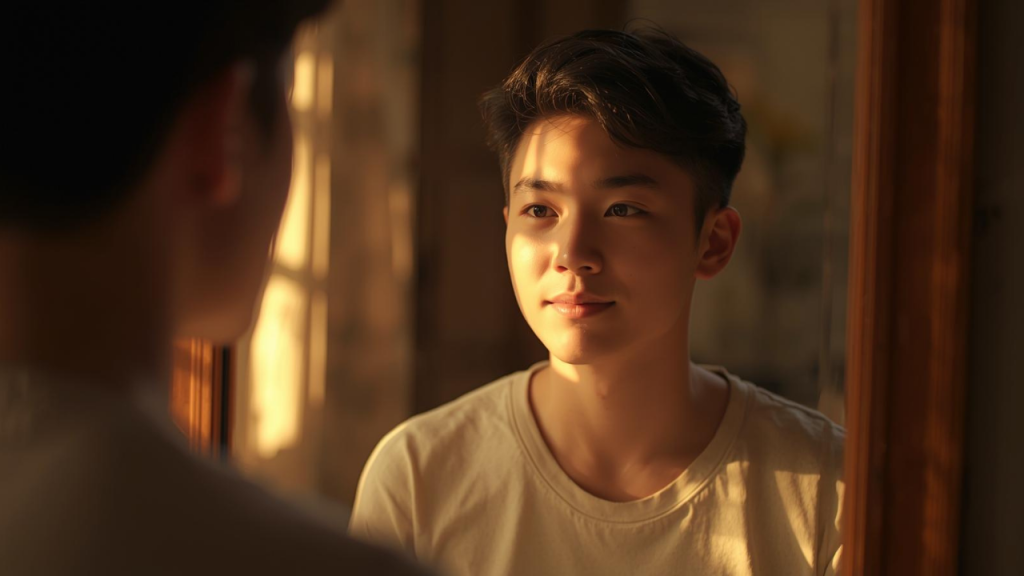

At sixteen, Aarav felt like a visitor in his own life.
Every morning, he followed the same routine—wake up before the alarm, wear the school uniform that felt more like a costume, eat breakfast without tasting it, and leave the house with a polite goodbye. From the outside, he looked like any other teenager: decent grades, quiet behavior, no trouble. Teachers liked him because he never caused problems. Relatives praised him for being “mature for his age.”
But inside, Aarav felt lost.
He often wondered why everyone else seemed to know who they were becoming while he felt like a blank page that someone else kept writing on. His parents talked about engineering. His teachers talked about competition. His friends talked about popularity. Everyone had expectations.
No one asked what he wanted.
Aarav had learned early how to blend in.
In school, he laughed when others laughed, stayed silent when opinions were loud, and agreed when disagreement felt risky. He didn’t hate his life—but he didn’t recognize himself in it either. There was a constant pressure to be something, someone, without knowing what that something was.
At night, when the house was quiet, Aarav lay awake staring at the ceiling fan, its slow rotation mirroring his thoughts.
Why do I feel like I’m pretending all the time?
Why don’t I feel like I belong anywhere?
He had no answer.
As a child, Aarav had been curious—endlessly so. He asked questions that made adults uncomfortable. Why do people lie? Why do we choose certain dreams? Why does being different feel wrong?
Over time, those questions were met with sighs and warnings.
“Don’t think too much.”
“Just focus on your studies.”
“You’ll understand when you’re older.”
So Aarav stopped asking.
Or at least, he stopped asking out loud.
Everything began to change during the school’s annual activity week.
Students were encouraged to join clubs—music, sports, drama, debate, art. Aarav walked past each classroom, watching groups of students laughing, arguing, creating. He felt like an outsider peeking into worlds he didn’t belong to.
Then he stopped in front of the drama room.
Inside, a group of students stood in a circle, practicing expressions. One student read lines from a script while others reacted—angry, joyful, heartbroken. Their emotions were raw, open, unfiltered.
Aarav felt something stir.
Drama had never crossed his mind. He wasn’t loud. He wasn’t confident. He didn’t like attention.
So why did his feet refuse to move away?
The teacher noticed him standing there. “Interested?” she asked.
Aarav hesitated. Every instinct told him to say no.
But instead, he nodded.
The first rehearsal was uncomfortable.
Aarav stood stiffly, unsure what to do with his hands, his face, his voice. When it was his turn to speak, his voice came out soft and shaky. A few students glanced at him, curious but not mocking.
“Again,” the teacher said calmly. “But this time, don’t think about how you sound. Think about how you feel.”
Aarav tried.
He imagined the emotion behind the line—fear, confusion, longing. Something inside him unlocked. His voice grew steadier. His eyes lifted. The words felt real.
When he finished, the room was quiet.
“That,” the teacher said gently, “was honest.”
Honest.
The word echoed in his mind all day.
From that day on, Aarav stayed back after school for drama practice. At first, he didn’t tell anyone. It felt like a secret, something fragile. But the more time he spent there, the more alive he felt.
On stage, he didn’t have to pretend.
He could be angry without being disrespectful. Sad without being weak. Loud without being wrong. Through different characters, he explored parts of himself he never allowed to exist.
Confidence didn’t arrive suddenly. It grew slowly—line by line, rehearsal by rehearsal.
One evening, as he practiced a monologue alone, he realized something surprising.
For the first time in his life, he wasn’t trying to be acceptable.
He was just being real.
The change didn’t go unnoticed.
His mother commented one day, “You seem different. Happier.”
His father noticed he spoke more during dinner.
At school, a friend asked, “Why are you always staying late?”
Aarav shrugged. “I found something I like.”
It was the first time he had said those words.
Still, fear lingered.
Drama didn’t fit into the future everyone had planned for him. There were no clear answers, no guaranteed success. Just passion and uncertainty.
Doubt returned late at night.
What if this is just a phase?
What if I disappoint everyone?
What if I’m wrong about myself?
The real test came when Aarav was chosen for a major role in the school play.
Excitement quickly turned into panic.
Standing on stage in front of hundreds of people? Letting everyone see him?
The old Aarav wanted to run.
But another voice—stronger now—whispered, This is you.
On the night of the performance, his hands shook backstage. His heart raced. He peeked through the curtain and saw his parents sitting in the audience.
Fear tightened his chest.
Then the lights dimmed.
The play began.
As Aarav stepped onto the stage, the world faded. The audience disappeared. He wasn’t performing anymore—he was living the story. Every emotion flowed naturally, honestly.
When the final scene ended, there was silence.
Then applause.
Loud. Warm. Real.
Aarav stood frozen, breathless, tears filling his eyes.
For the first time, he felt seen—not as what others expected, but as who he truly was.
After the play, his parents hugged him.
“You were amazing,” his mother said softly.
His father looked thoughtful. “I didn’t know you had this in you.”
Neither did Aarav.
That night, he sat by his window, city lights glowing in the distance. He realized something important.
Discovering who you truly are doesn’t happen all at once.
It happens in moments—
when you choose curiosity over fear,
honesty over approval,
and courage over comfort.
Aarav didn’t have all the answers yet.
But for the first time, he knew one thing clearly.
He wasn’t lost anymore.
He was becoming.


